Sunday, August 28, 2011

Hurricane Irene and memories of our East Coast tour

On May 11th I created this small watercolor sketch while staying at the Otway House in North Carolina. The following day we rode our tandem bicycle to the Ocracoke Island Ferry in the Outer Banks. There are no bridges to Ocracoke. A few days ago I read that the island had been evacuated. Yesterday I learned that Hurricane Irene hit mainland at Morehead City, NC, a mere 10 miles from the Otway House where we stayed. I hope that beautiful B&B and this fishing boat parked behind it still exist after nature's fury. The news reports have Bob and I recalling the places we visited on our extended bike tour, documented daily if you take that link. It's difficult to reconcile the images of the hurricane hitting these areas with our memories of hot, mostly dry weather, all the way from Key West into New York State where we got rained on during the last days of our ride to Portland, ME.

I keep thinking about my sons; Jason lives north of NYC in the Hudson River Valley, and Jeff and family live in North Danville, VT. I am scouring news reports to see how they are faring. I see online that my Vermont family can use an emergency shelter at St. Johnsbury Academy, but they are situated on high ground and expect to weather the storm at home. I see my brother Dave's town, Brattleboro, is under water and residents are being advised to get to the highest point in their residence. I have a very large family in my home state of Vermont and New England.

The sketch was done using my tiny Koi field watercolor set of pan paints and brush with water in the handle as I sat on the wrap around porch that evening. I like the line work that seems to go so well with a fishing boat.


Sunday, August 21, 2011

"Family Duet"
16" x 15"
Arches 300 lb. hot press

Kelly and Grandpa Bob play the flute

Finally, time to paint! I began this piece before I left in March for my long bicycle tour and trip to Europe. You can see the start here. As I described in that post, Bob played flute with granddaughter Kelly when my son's family visited us from Vermont in July 2010. When I took the photo, I grabbed it quickly and without their knowledge. I don't do my compositions with the camera, so I didn't mind that I did not have a real tight shot of Kelly and Bob. I had enough information to draw the figures. (This photo also served as source for a painting of Kelly that I did in acrylic. I created the background from imagination.)

I closely cropped the drawing so there is a sense of one, not two, subjects. I used Arches 300 lb. hot press, which I discovered I like for figure work when experimenting in Ted Nuttal's workshop. I layered the background, starting with a pale yellow/cadmium scarlet over which I put several thin washes of thalo blue/cadmium scarlet. I wanted a mottled finish, so I mixed the colors on the paper and finished with an extra caligraphic wash in the top third.

Kelly is not only a flutist, but a competitive horsewoman as well. I was so pleased to learn that yesterday Kelly did her first ever gymkhana on Spirit, her white horse. Kelly, 15, competes now in a class that can include adults and does not have the immensely expensive horse and tackle, nor a hired groomsmen. Kelly told her Mom she was just going to take it easy and get experience in the event. Apparently, Spirit has done this type of competition with her previous owner, and when she heard the starting whistle, she was off like a shot. Kelly always does well in horsemanship classes because she is an excellent rider. They took third place! I can see this pair doing more gymkhana.

Sunday, August 14, 2011

SCVWS Drawing Workshop completed

Sketching exercise in sanguine Conte on white paper

Last night I completed coordination for a three-day workshop for Santa Clara Valley Watercolor Society. My Monday drawing instructor, Robert K. Semans, was the guest artist. Bob is an impressive and successful artist. Drawing seems like it should be simple to learn, but we participants can tell you otherwise. I overheard someone say at the end of the workshop, "I thought I knew how to draw."

The room was set up with four still lifes that would give us practice in the various principles of drawing and gave us ample opportunities to practice measuring using a dowel stick to check our accuracy. We rotated through the four tables during the first two days. We sketched in charcoal and conte. My conte drawing of the basket was my most complete and interesting piece. It was challenging to get different values using the Sanguine, which cannot provide a full range of values.

On the final day, Jane Ferguson, a fine artist herself (take that link to check our her website) and professional model, sat for us until mid-afternoon. I've sketched and painted Jane before and I did one large painting of her that is one of my favorites.

Bob had us do warmups with 5 minute sketches. that really forces you to go for the gesture. Bob demoed how to do that with quick fluid lines.

5 minute sketch

Later we got to do some 25 minute sketches. You can see that Jane is great about changing outfits. The two she selected for the longer poses enabled us to see the underlying body structure.

Jane posed

We sketched for 25 minutes

Our instructor, Bob Semans, demos how to approach a longer pose


Jane's final pose for 25 minutes

My final sketch

Bob did a critique of our last sketch and used the critique as a jumping off point to review some important concepts about drawing from life.

Wednesday, August 10, 2011

Drawing workshop coming up

"An Apple a Day"
12" x 16" pastel


You might ask what happened to Ireland. Joan and I loved our visit from July 9 to 14. We were so busy having fun that I did not paint or sketch at all. Joan actually did a small watercolor of the lighthouse at Howth to give to the woman who took care of us while staying at the guesthouse. I'm afraid I didn't get a photo. In our short time there we attended Riverdance, the National Symphony, and Evensong service at St. Patrick's National Cathedral sung by Trinity College and St. Patrick's choral. We took a bus tour across the country, and a city tour, visited the National Museum to see a Carravagio, and spent a day in Howth on the coast. I expect I will eventually do some Ireland-inspired art, but many events are taking precedence.

On Friday I begin coordinating a three-day drawing workshop for the Santa Clara Valley Watercolor Society. The workshop committee was asked numerous times for a drawing workshop, so I arranged for Robert K. Semans, the instructor of my weekly drawing class, to teach a workshop. Bob is a very accomplished artist and you can read a bit about him in the SCVWS newsletter.

I started the pastel shown at the top of the page the single Monday I attended class after my lengthy trip. Progress was stalled by jury duty. Thus I added a bit of color at home without benefit of the still life setup to complete the piece to this point. I don't consider this one finished. Sorry, the colors are not very accurate in this photo.

Below is a piece in progress, but I will not get to complete this one because the group finished their two-week session this past Monday, my first day back in class, and are moving on to other subjects. I decided it's a good example of how we approach drawing this type of subject. Bob and our group sets up the still life on a table under a natural skylight. If we can do without artificial light, this setup provides the best highlights and shadows for creating the three dimensional form.


Bowl of fruit in progress

Selecting a toned paper, I first look at size, shape, and placement on the paper. Using a dowel stick, I measure the relationship of height to width and determine how large I want to make the subject. I use vine charcoal to do the drawing, checking my accuracy with the dowel stick. Bob prefers charcoal over graphite because it provides a broader range of values. Vine charcoal is great for laying down the drawing because it easily erases with your finger.

Next, using vine charcoal, I separate the values, ensuring I identify where the highlights occur and keeping them clean of pigment. Thus, you can see the bowl and the shadows remain in charcoal at this stage. I also had indicated very dark values for the plums and lighter values on the colorful fruit and gourd. I then took the piece outside and put a light spray of Workable Fixative over the charcoal.

For those of us who have taken multiple years of drawing in this class, Bob allows the use of pastel on our drawings. Newer students continue to develop work in charcoal and later in conte. To achieve some of the richest colors, I have to mix charcoal or black pastel with a color (I prefer to use a charcoal pencil). Here I used a magenta pastel with charcoal to obtain the deep, rich color of the plums. Highlights are indicated on these colorful fruits with a cream charcoal. White would be too severe and unnatural. I would continue to develop the painting by carefully comparing relationships of value and color. This process reminds me of my workshop in France where we were constantly comparing relationships. Art is art, no matter what medium you use.

Either during or after the weekend, I will show you art from the workshop.

Sunday, August 7, 2011

Our art show in Provence and heading to Ireland

Some of my paintings on display at our "Vernissage"

Our instructor, Maggie Siner, met personally with each of us for 15 minutes on Friday afternoon. We discussed what we had accomplished and Maggie selected works to hang for our evening art show. At 7 we gathered in the studio and invited guests joined us, people from the village that know Maggie, David, and Elizabeth. We had a lovely selection of appetizers and wines. Joan and I were asked to make thank you cards for Maggie, David and Liz, and Trish.

Instructor Maggie Siner stands near the refreshment table

The show was truly a powerful ending to the workshop. We were gratified to see our works on display and had a sense of accomplishment. I was humbled by Maggie's personal thanks for being an enthusiastic participant and her comment that my work stood up well against strong oil paintings. One of the visitors was immediately drawn to my painting of the olive grove.

This small display included one of my pieces on the lower right


Joan Kendall, my artist friend from Connecticut, beside her works on display

Marie from Paris stands between her paintings and mine

Leslie Powell from North Carolina next to her beautiful work

Sally Levie, a Washington, DC, area artist presents our gift and card to Trish Adams, our coordinator

The following morning, Joan and I arose very early to await our private taxi to Marseille Airport. We went into the kitchen hoping that we might find something light to eat before our long ride. David and Liz had thoughtfully placed croissants on the table for us, and we heated some tea water. We sat on the patio savoring our final view from Les Bassacs in Provence. Several hours later we landed in Dublin.

Breakfast on the patio

Early morning by the pool

Dublin awaits

And Connamara

Sunday, July 31, 2011

The Provence workshop, a continuation

"Silver-tinged Olive Grove"
Near Croagnes, Provence, France

Jury duty has kept me from writing more about my trip to Provence, France, for an art workshop. A few more days and my civic responsibilities will be done. Meanwhile, I find that like the trip, I don't want the writing to end either! So what you get today is our final morning of plein air painting. Yet to come is our show on Friday evening and our departure to Ireland on Saturday morning.

For years I have done daily exercise, which I believe (along with luck) has resulted in my ability to remain active in retirement. So Joan and I would rise very early each morning and take a long walk before breakfast. There were several narrow unpaved roads to choose from, but we identified this walk as our favorite.

The beginning of our favorite walk

We would exit our home for the week and go around the back to this tiny road between village walls. Les Bassacs is on a hill, so we walked down into a small valley filled with vineyards and orchards.


Across the valley the small village of Croagnes was perched on a hill. The town is made up of a church and a few wonderful stone houses with a cemetery on the hillside. We understand the residents don't appreciate artists with easels, but no one complained about our walks.

The town of Croagnes with its pretty church as seen from the valley below Les Bassacs

Another fork in the road had this view of our home as we looked back from the dirt road. This memory is begging to be painted.

Our home in the early morning light

Friday was our final day of the workshop. David drove the van a few miles to an olive grove just past Croagnes. Maggie said this grove would be a challenge in painting greens. I thought, whoa, this IS a challenge. Maggie said not to think green, think blue/purple or yellow/orange. I actually got so literal on my paintings that what you see isn't green. We also would be doing two paintings simultaneously as the sun came and went behind clouds. The painting at the top of this post is my cloudy sky painting. You can compare it to my sunny sky painting here. What you will see is less warm color in the cloudy painting, especially in the foreground. Mostly we had sun, so I had about 25 minutes to work on the cloudy sky painting.


The two paintings rest on the easel in the olive grove


My view for the cloudy sky painting

Here is Joan's painting done in oils -- really lovely. Joan was painting about 20 feet away from me.

The olive grove
(c) Joan Kendall

I was happy with what I had accomplished this morning and in the workshop. David came in the van to take us to our final lunch together as a group. We relaxed and then it was into the studio for individual conferences with Maggie, cleanup, and preparation for our evening "Vernisagge."

Sunday, July 24, 2011

More plein air painting at the Provence workshop

"Almost Heaven"
Saint Saturnin Les Apt
Church in sunshine

"Late Day at Saint Saturnin Les Apt"
Church in sunshine

Painting at Saint Saturnin Les Apt after our picnic dinner
Cloudy day painting on the easel and sunny day painting below

Tonight we would enjoy a picnic so we could paint in the late day light . David ferried us to a town just a few miles from Les Bassac over narrow country roads, pointing out the vineyards at the winery that is the source of our lovely table white and red wines. We arrived around 4 p.m. on a hillside across from an active church and the remains of the walls from a chateau that housed the towns. The remains sit high above a gorge containing the town reservoir. This narrow strip of hillside drops hundreds of feet on the other side as well. In more peaceful centuries, the town has moved down the hill where there are luscious red rooftops to tempt an artist skilled in perspective.

Joan and I decided we had to climb down our hill, cross the top of the dam, and walk up the narrow cliffs to the church. Joan and I got a real bonus. The church was open with a couple touring the inside so we walked in. The church is a lovely old place with original paintings, simple chairs set up for service, and a small altar. It was obvious that the locals worship here to this day. A woman appeared and waved a large key, letting us know that she was locking up now.

We had a mixed lighting situation. Maggie told us we must be prepared to do two paintings simultaneously, one cloudy and one sunny as the colors and relationships will be very different. I got ambitious and started a large cloudy painting. Oops, there goes the sun, so I grabbed another piece of paper and without any lines, used Maggie's lesson on carving out the negative shapes and dark shadows to begin a sunshine painting. Whenever the light changed, which was frequently, I grabbed the other painting and continued to work.

Maggie got to teach me on the spot, which I appreciated. The clouds kept covering the sun, then breaking. We could easily discuss the differences in color and relationships. The first painting at the top of the post is my sunshine painting and the third photo shows it resting on the ground under my cloudy skies painting. Already the light and shadows were changed in this photo from the time I began the sunny painting.

If you are considering painting plein air and wonder about setup, the third photo shows you what I take in the foreground (the stool and other easel belong to others):
  • Sun Eden easel (I left the very large backpack at home as I needed to travel light), purchased online
  • Kiva backpack, very light and folds into itself when empty to become a lightweight purse on a strap (great when I shipped my art supplies to Joan), purchased at an outdoor sports store; the easel sticks up above the top and I pull the flap over it
  • Homee half palette to hold tube paints placed on the easel tray; once filled, I wrapped it inside a plastic bag and hand carried it upright to the locations, purchased online.
  • AquaTote collapsible plastic cloth bucket to hold my water, which I carried in to disposable water bottles in pockets on the side of the backpack; I hung the bucket by the handles from a hook under the easel tray, purchased online
  • Various sizes of Arches 140 lb. cold pressed watercolor blocks (equivalent to quarter and half sheets); I found the half sheet size nice for doing simultaneous paintings when I divided it with masking tape; the blocks eliminate the need to carry a support
  • Small selection of brushes in a homemade roll-up cloth brush holder.
  • Camera, drawing implements, kneaded eraser, sketchbook, tube paints, masking tape
  • Layers of outer clothing
  • At home I might add a three-legged stool, though I generally prefer to paint standing up
I packed the painting supplies and my clothing in one piece of luggage, the size one up from a carryon, for checking on the airplane, thus my limited wardrobe in the photos. We did some laundry by hand and hung small items on a little rack in Joan's room and larger items on the clothesline.

Eventually we took time out for a lovely picnic of puff pastry with break crumbs, cheese, tomatoes, and garlic; couscous; carrot salad; local cheeses and breads; and vanilla mousee accompanied by the local wine. The area had a huge cement picnic table and some of us smaller folks looked like Lilliputians perched on it.

Marie awaits our picnic dinner

It was back to painting and I began a second clear sky painting, never able to return to the large cloudy painting because of the sky conditions. The second painting is the second piece at the top of the post. You can even see the difference in lighting situations between the first sunny painting begun about 4:30 and the second one begun about 7:30. I leave you with a third lighting condition that I never got to paint. I took this photo as we were preparing to leave for the evening. The Artmobile rolled downhill filled with a group of contented and tired artists.

Soft evening light -- a future painting?

Friday, July 22, 2011

More on the workshop in Provence

"Ochre Quarry at Rest"
Near Roussignon, France

"Nature's Colors"
Ochre Quarry near Roussignon, France


On Wednesday, we left Les Bassacs at 8:30 to travel to the small village of Goult. We had a choice to paint in the cemetary or the village, and Maggie demoed using the interesting shapes of the topiary trees and the monuments to create a shape painting filled with light and shadow.

One topiary tree is visible beside the right-most monument
Cemetery at Goult, France

Most people went out and painted in the village, but Joan and I parked ourselves in the shade in the cemetery. This was my crash and burn morning, and Maggie had to talk me through it! Here is Joan's wonderful painting.

The cemetery in Goult
(c) by Joan Kendall

Joan would tell you this is a departure from her more realistic oils, and Maggie deemed it very successful. That afternoon we could shop in the city of Apt or stay at the village. We chose to stay at the village, rest, read, do laundry, and sketch. About 9 p.m. we adjourned to the studio after dinner where Maggie presented a slide show of works by some of the masters.


Entrance to the village house where David and Liz hosted our workshop

Thursday was a hoot. Kind of like being a hog in hog heaven. Picture 10 artists clambering around an ochre quarry where in past centuries miners dug pigments to make artists' oils and watercolors. The quarry is near Roussignon, a town that is very golden reddish from the rocks used to build the village. Ochre is a yellow/brown/red/purple pigment derived from clay containing mineral oxide. This quarry has been abandoned for some time because much of the paint today is produced chemically, rather than using the natural pigments. The old quarry was a maze of unusual shapes, canyons, and hills, and trees have taken root in places.

Ochre Quarry near Roussignon

We clambered over it. This is one of the reasons I joked about art as an extreme sport. We reveled in it.

Artists selecting a spot to paint.


Marie, Sally, and Michelle join me with expressions of joy

Love those purples

After climbing over the quarry, we set up our easels and began to paint. I had my six colors which did not include ochre or burnt sienna, colors that abounded. No problem; we mixed our own. I strongly considered grabbing some of the dirt and dropping it on my wet surface, but feared I might make a complete mess. The two paintings at the top of this post were done on location at the quarry. The top one was the first one I painted and took a couple hours. The second one I painted in under 30 minutes. The workshop reinforced for me that painting one subject multiple times helped me really know that subject. Subsequent paintings were much easier for me. As a group we took home some very exciting work when David arrived at 12:30 to take us back home for lunch.

Joan and Trish Adams, coordinator and artist extraordinaire, take time out from painting

Trisha Adams was the organizer for this workshop and she did a superb job. She is kind, upbeat, and accommodating. She is also a very successful artist and instructor. I was impressed with the caliber of people who took this workshop from Maggie Siner. Go here to see Trish's art and accomplishments. Trish painted this gem in the quarry.

Ochre Quarry
(c) by Trisha Adams

I leave you at midday as we enjoyed our fabulous meal of the freshest ingredients prepared and served by David, Liz and their capable helper.

Wednesday, July 20, 2011

More on the landscape workshop

"Heavenly Light"
Bonnieux, France


Michelle in Bonnieux where Joan and I painted the light and shadows on the church

Each painting session began with a ride in the van to our location. Joan and I fondly dubbed it the Artmobile. Loaded with easels, each painters supplies, and the painters, the Artmobile headed out over the tiny roads of Provence to deliver us to the location where we would paint for several hours. Here are Joan and I ready to board.


On Monday we were challenged with rain, an unusual event in this Meditteranean climate in July. We went to the village of Murs in the morning to paint looking up at the village. The lesson was on how to paint on a gray day. The difference is stunning -- there are no shadows, but there are some indications of light and dark planes. After one false start and some advice from Maggie, I completed this light sketch. At one point we had to secure our easel and paintings and take cover in a stand of trees until the rain lightened up. Maggie is spare with detail and this painting has a bit more than she would have painted.

"Rainy Day Mondays"
Murs, France


Marie from Paris paints the walled city of Murs on a rainy day

With the challenge of rain for the afternoon, Maggie decided to paint either in the studio or on the grounds of our home. She offered to set up a still life, which Joan and I decided to paint. I learned a lot from this little exercise. I was busy carefully using my dowel stick to draw the still life when Maggie came by and told me to stop because the result would look like a coloring book. She said the reason we take drawing lessons is we have the knowledge to branch out. She demoed creating just the negative shapes with her brush and oil paint. I was reminded of Michelangelo saying the figure was in the marble and he just removed the parts that were not the figure. I first protested that I couldn't do this in watercolor, but Maggie insisted I could, and I did. Though this sketch is much too light for a finished piece, it is painterly and I like it. The evening ended late after Maggie gave a lecture on color, just in time for our next day's challenge.

A study of light and shadow on a still life

The following day dawned with bright sunshine so it was off to the walled village of Bonnieux to learn about the color of light and its complementary shadow color. As we watched Maggie do a quick demo of the village portal, it was obvious that the sun would be brutal, so Joan and I selected a shady spot in a park. Here we painted one small portion of the old church. The painting is displayed at the top of this post. Maggie told me this was quite a successful piece. Maggie had us start with an underpainting of light and shadow shapes and then add bits of color to define the textural qualities. I followed her directions using yellow/orange for the light and blue/red for the shadows. I had time to look over the village wall and enjoy the valley filled with lavender fields, so very Provence.

A view of the lavender fields and mountains from Bonnieux

After lunch and a brief rest, we piled into the Artmobile for our journey to Piberny, between the villages of Lacoste and Bonnieux. We would be left her from 3:30 to about 9, with a lovely picnic. David, our host and a superb artist, stayed to paint that afternoon. We stood looking up at Bonnieux on one side and the mountain range that includes Mont Ventoux of Tour de France fame on the other side. We were in vineyards and orchards. I made a failed attempt at painting a large landscape and quit before I finished. Maggie explained that I did not limit the scene enough. Lesson learned! My friend Joan was far more successful, doing a beautiful vista that included the vineyards.

Vineyards
(c) by Joan Kendall

After our lovely picnic in the cherry orchard, everyone spread out to do a painting under fading light. I did a 15-minute sketch of Bonnieux which Maggie really liked and would later include in our show, even though it was not complete. She said you can get away with that with watercolor. We drove back to Les Bassacs in soft evening light.

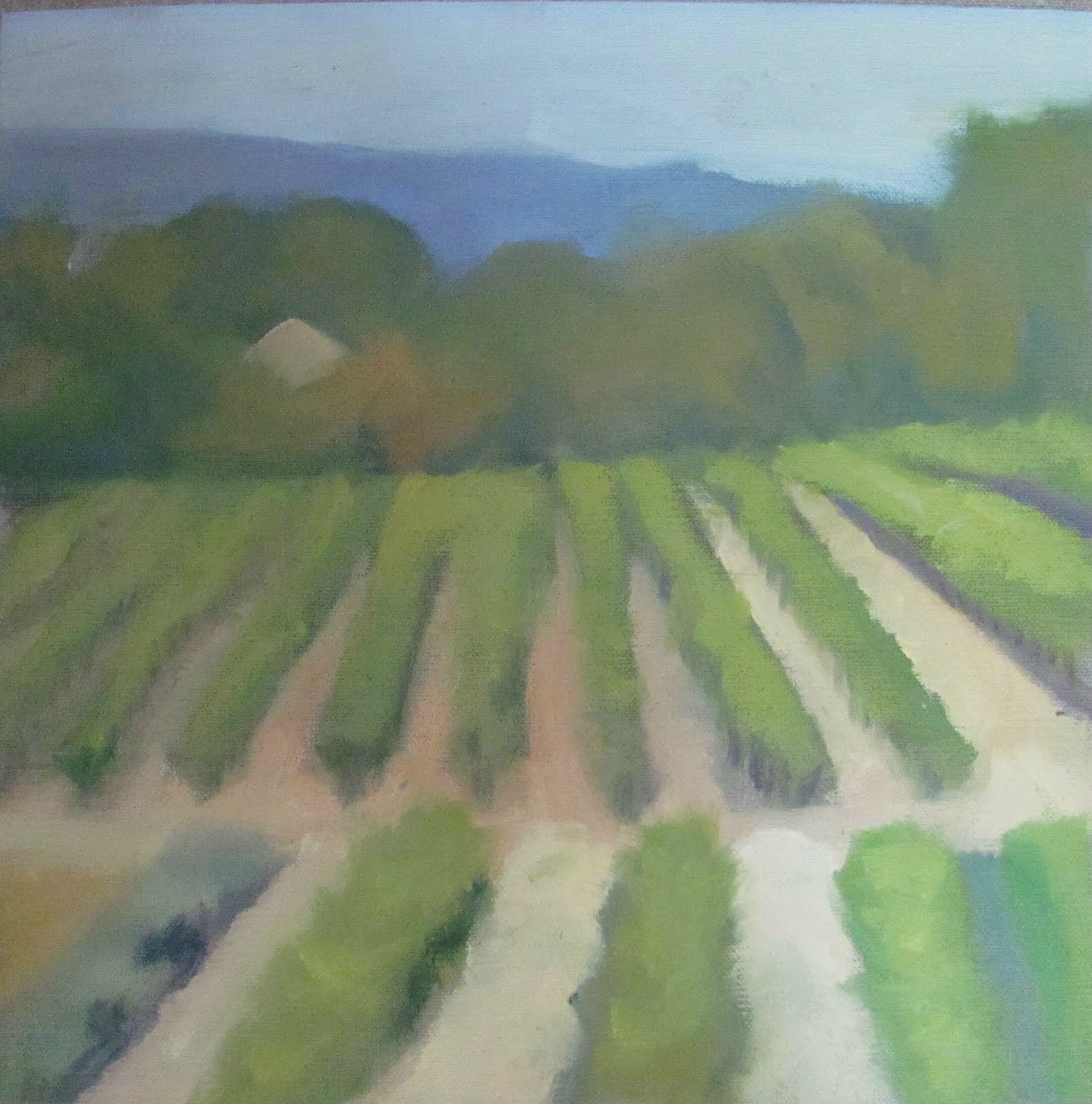
Bonnieux from Piberny where we painted and had a picnic


A 15 minute sketch of Bonniex from our picnic spot